
Application scenarios:
1. In the field of power engineering
• Urban power grid renovation, substations, and power plants:
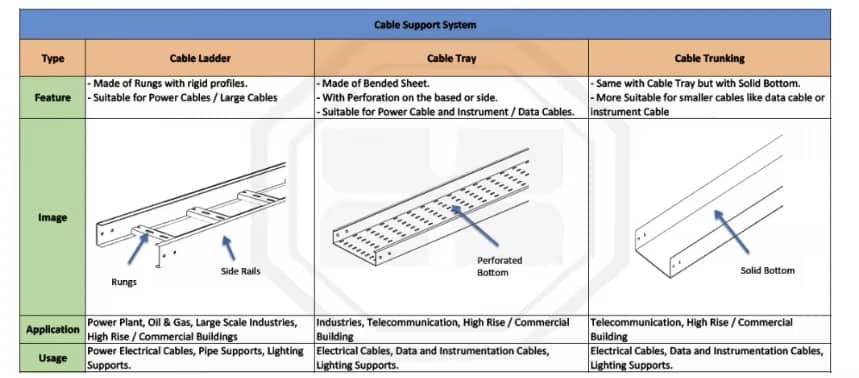
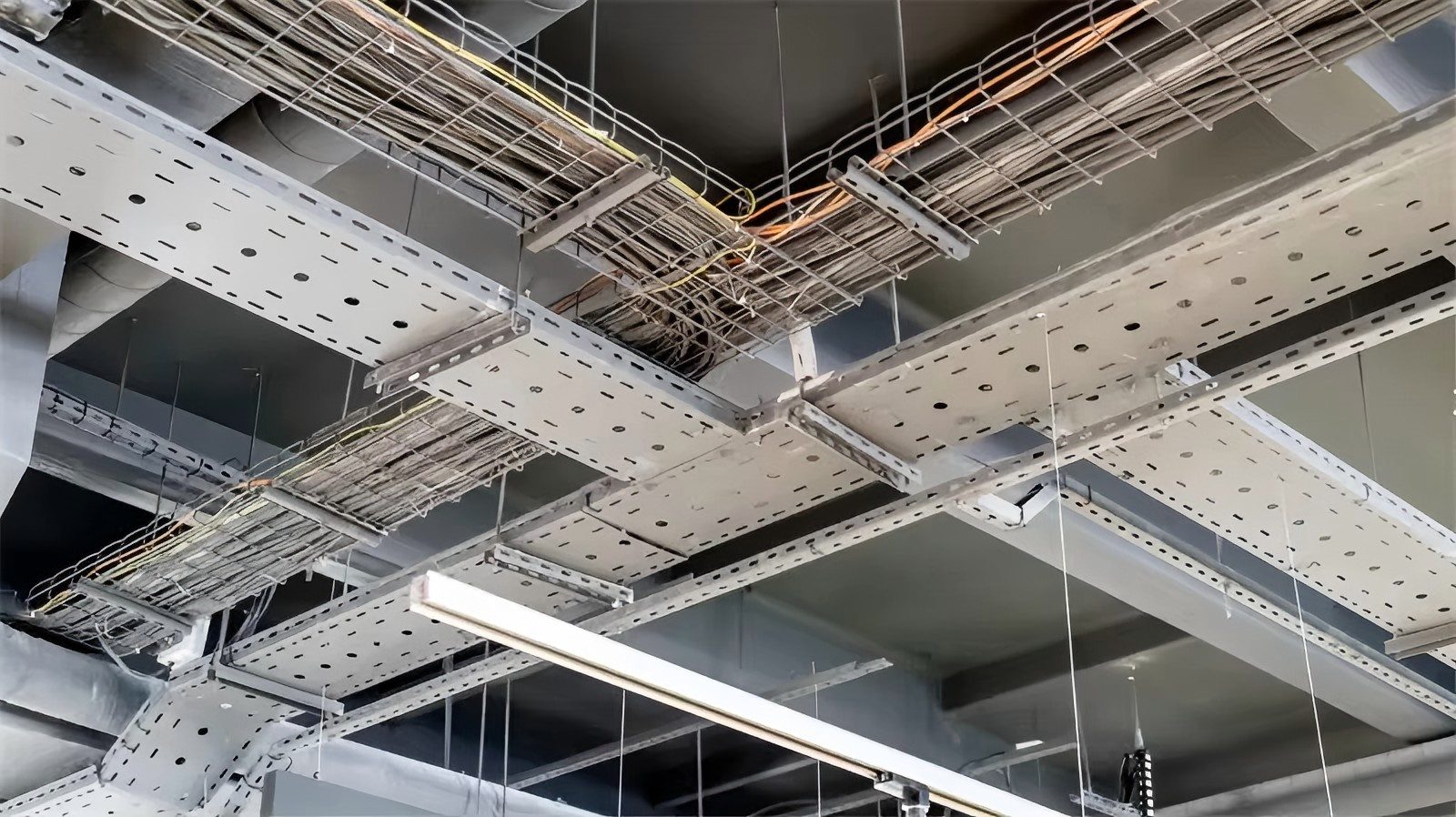
used for laying high/low voltage power cables, ladder style and large-span cable trays suitable for high current and large cross-section cables, with good heat dissipation and meeting the safety requirements of power transmission.
• Residential communities, commercial complexes, and office buildings:
trough type and tray type cable trays are used for indoor strong and weak current cable laying, standardized wiring, easy maintenance, and adaptation to building power distribution systems.
2. Industrial manufacturing field
• Factory workshops and production lines:
laying power cables and control cables for various types of factory buildings, suitable for industries such as mechanical manufacturing, automotive, electronics, textiles, and food processing, to meet the complex wiring and equipment power supply needs of workshops.
• Chemical, metallurgical, and mining industries:
products produced by stainless steel and anti-corrosion coating bridge forming machines, resistant to acid and alkali, high temperature, and corrosion, suitable for cable laying in harsh industrial environments.
Equipment Introduction:
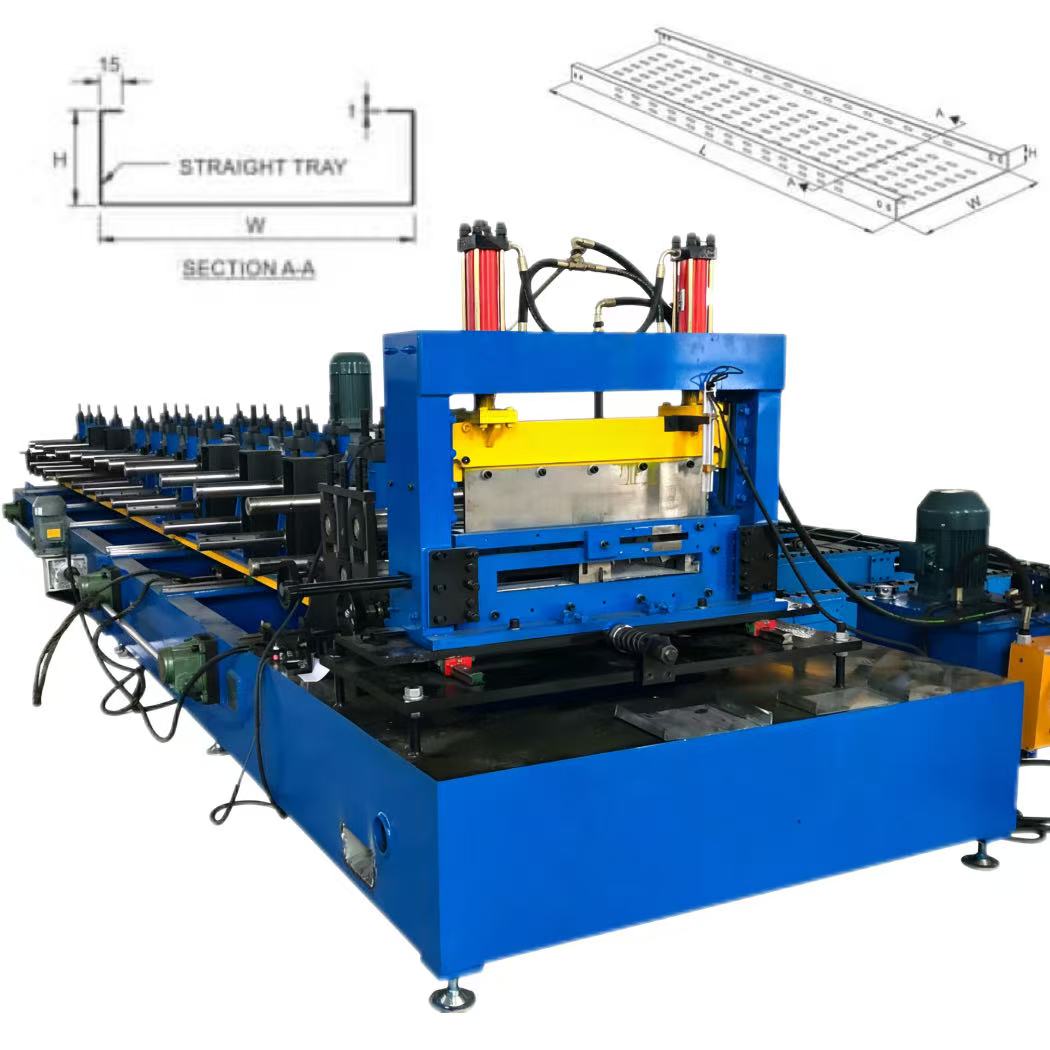
The Hot Sale Size Fast Change Cable Tray Roll Forming Production Line is a specialized cold bending equipment for automated and continuous production of cable trays (trough, ladder, tray, mesh format, etc.), and belongs to the core equipment of metal sheet cold bending processing. It gradually bends, punches, cuts, and forms galvanized steel plates, cold-rolled steel plates, stainless steel plates, and other coil materials through multiple sets of rollers, completing high-precision processing of core components such as bridge side plates, bottom plates, cover plates, ladder edges, and crossbars in one go, replacing traditional dispersed processes such as bending and welding, and achieving large-scale and standardized production of bridge products.
Core components of the equipment: unwinding machine, leveling machine, servo feeding machine, punching unit, cold bending forming host, tracking cutting machine, discharge table, PLC electrical control system, hydraulic system, etc. It can be customized as a single unit or linked production line according to the specifications, thickness, and production capacity requirements of the bridge.
Product Attributes :
|
1.Formed Material
|
PPGI,GI,AI
|
Thickness:200-1130 mm
|
||
|
2.Decoiler
|
Hydraulic automatic decoiler
|
7T
|
||
|
3.Main body
|
Roller station
|
22 rows(As your requirement)
|
||
|
Diameter of shaft
|
80mm solid shaft
|
|||
|
Material of rollers
|
45# steel, hard chrome plated on the surface
|
|||
|
Machine body frame
|
Metal steel welded
|
|||
|
Drive
|
Chains transmission
|
|||
|
Dimension(L*W*H)
|
35×1.5×1.6m
|
|||
|
Weight
|
About 60KW
|
|||
|
4.Cutter
|
Automatic
|
cr12mov material, no scratches, no deformation
|
||
|
5.Power
|
Motor Power
|
5.5KW
|
||
|
Hydraulic system power
|
7.5KW
|
|||
|
6.Voltage
|
380V 50Hz 3Phase
|
As your requirement
|
||
|
7.Control system
|
Electric Box
|
Customized(famous brand)
|
||
|
Language
|
English(Support multiple languages)
|
|||
|
PLC
|
Automatic production of the whole machine. Can set batch, length, quantity, etc.
|
|||
|
18.Forming Speed
|
5-10m/min(customized)
|
The speed depends on the shape of the tile and the thickness of the material.
|
||
Core Features:
1.High-precision molding with stable dimensions
• The multi-pass progressive cold bending process is employed, with rollers precision-machined via CNC to achieve a forming accuracy of ±0.5mm. This ensures uniform bridge tray slot dimensions, edge heights, and bending angles, eliminating errors in splicing and installation, and compliance with industry standards such as GB/T 23639.
• Servo closed-loop control for feeding and cutting, with a length error of ≤±1mm, eliminating dimensional deviations caused by manual operations and suitable for batch standardized production.

2. High level of automation, efficient production
• End-to-end PLC + touch screen intelligent control allows one-click setting of cable tray specifications (width 100-1200mm, height 50-300mm), thickness (0.8-3.0mm), and length, automatically completing uncoiling, leveling, punching, forming, cutting, and discharge without manual intervention.
• The continuous forming speed can reach 8-25m/min, with single-shift production capacity reaching several thousand meters, achieving a 5-10-fold efficiency improvement over traditional processes and significantly reducing labor costs.

3. Strong adaptability and wide processing range
• It can process various materials such as galvanized sheets, cold-rolled sheets, stainless steel sheets, and aluminum alloy sheets, meeting diverse requirements for corrosion resistance, load-bearing, and environmental conditions.
• The product line includes a full range of series such as trough-type, ladder-type, tray-type, long-span, and fireproof cable trays. It supports integrated composite processes including punching (heat dissipation holes, mounting holes), embossing, stamping, and flanging, enabling one-time molding without secondary processing.

4. Stable operation and strong durability
• The host rack is made of thick steel plate welded and annealed, with strong rigidity and long-term operation without deformation; The rolling mill is made of alloy tool steel such as Cr12MoV, which has been quenched and nitrided to achieve high hardness, wear resistance, and a service life of 8-10 million meters.
• The hydraulic and electrical core components adopt well-known brands with low failure rates; Equipped with safety protection devices (emergency stop, protective cover, overload protection) to ensure production safety.

5. Energy saving and environmental protection, low cost
• Cold bending forming has no heat processing, no waste, and low noise. Compared with welding and casting processes, it reduces energy consumption by more than 60% and meets the requirements of green production.
• Continuous processing of coil materials, with a material utilization rate of over 98%, reducing waste of corner materials; After forming, the bridge has high strength and good flatness, without the need for subsequent polishing and calibration, reducing post-processing costs.
